Somatic Support for Voice Educators
Embodied presence, voice, and movement exploration
for teaching and learning
Teaching and learning happen with and through our whole body — including yours, as the educator.
As voice educators, we are constantly sensing, noticing, responding, and attuning to our students. Our bodies, voices, breath, body position/shape, and (nervous) systems are always part of the learning environment. Whether we attend to these processes consciously or not, they shape how we show up with students, and how we experience ourselves in our work.
This offering is for voice educators and emerging teachers who want somatic support for their teaching practice: not more techniques to apply, but deeper access to their own embodied experience as a source of presence, clarity, awareness, and more possibility.

Waking Up to Your Embodied Knowing
This work supports educators in reconnecting with your whole being as a source of information, responsiveness, and adaptability.
Rather than focusing on what to do with students, together we can explore:
how you are already teaching from your embodied knowing
how your voice, movement, gesture, and sensation shape your presence and communication with your students
how expanding embodied awareness can support the teacher-student relationship, your response-ability, and ease
The aim is not self-improvement or skill acquisition, but deepening self-knowing: allowing your teaching to arise from your lived experience rather than effort or performance.
Experiential, Not Instructional
Sessions are experiential rather than didactic.
This means:
practice before theory: having an experience before an explanation or “why” is offered
allowing your knowing to emerge through experiencing your sensations and emerging awareness
receiving first, integrating later
letting application unfold naturally, in your own way and teaching style
The work we do together is not a how-to or set of techniques to apply.
It is an invitation to explore, sense, and discover what supports you, first as a human, then as the whole, magnificent, aware educator you already are.
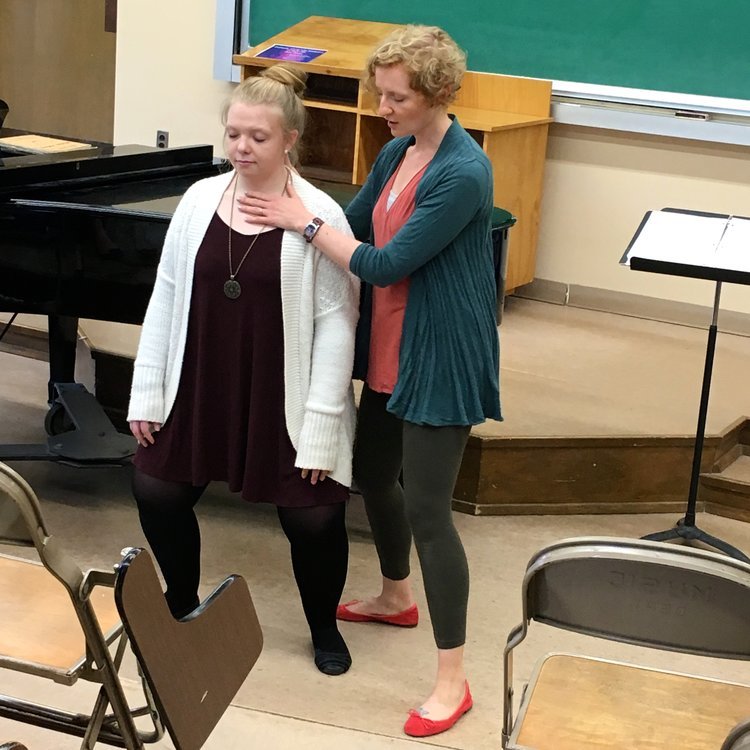
Voice, Movement & Embodied Learning
Your voice is your body.
Your body is your voice.
Voice, movement, and sensation are inseparable from how we communicate, learn, and relate to ourselves, our students, and our environment.
My approach explores the intersection of:
embodied, relational awareness
somatic voice and movement exploration
Developmental Somatic Psychotherapy (DSP), the work of Ruella Frank
Alexander Technique and Wholeness in Motion (WIM) principles
In our co-created explorations, principles of the Alexander Technique, WIM, and DSP provide the theoretical and experiential scaffolding for your emerging physiological awareness. This is particularly useful when discerning what may be interfering with your sense of ease, clarity, or response-ability in your teaching and daily life.
These frameworks inform how we explore embodiment, voice, and presence within an educational context.

Defining “Sense-able”: Awakening Sensory Awareness
A core aspect of this work is expanding your capacity to attend to sensation and receive information through all of your senses.
Explorations may support:
awakening your sensory sensitivity
refining your attention to subtle bodily cues
deepening your ability to receive information - from inside yourself and the environment - through movement, sound, and stillness
trusting your bodily knowing as part of your pedagogical intelligence
As sensory awareness grows, many educators notice:
increased presence and flexibility while teaching
reduced cognitive effort (less trying to “figure it out” or “get it right”)
greater trust in your moment-to-moment knowing
renewed vitality and curiosity in your work
Ways We Can Work Together
One:One Somatic Consultation
(In-Person or Virtual)
Individual sessions offer dedicated space to explore your unique embodied experience as a voice educator.
Sessions may include:
embodied voice exploration
movement-based awareness practices
attention to your breath, body position/shape, and qualities of movement
Both in-person and virtual sessions support deep awareness and integration through curiosity, experimentation, and exploration.
Workshops & Group Experiences for Educators
I also offer workshops and group experiences for:
voice educators
student teachers
voice-users in educational roles
Group offerings explore:
your embodied presence in teaching and learning relationships: does your connection to yourself change when you are with students?
your voice as a resource for communication, expression, and “settling” in your body
movement and sensation as supports for your awareness and ability to adapt/orient to a shifting environment
co-regulation and response-ability in educational settings
Workshops can be offered:
in person or online
as standalone experiences
or co-created for programs, institutions, or peer groups

A Note on the Evolution of This Work
As of January 2026, I no longer offer stand-alone voice and movement teaching in the traditional instructional sense.
This work is now offered as:
somatic consultation for voice educators and facilitators (and therapists)
embodied exploration within reflective learning spaces
workshops and group experiences grounded in lived experience
The more I explore the integration of embodied voice, somatic exploration, and being our whole selves, I keep finding that how we experience our voices and our felt-sense is central to how we understand ourselves, each other, and the world.
An Invitation
This work is an invitation to:
slow down
feel more
trust your embodied intelligence
allow your understanding to emerge organically
Supporting your embodied presence is not an extra skill you need to master.
It is foundational. It is already happening in you, we are simply bringing what you already intrinsically know into clearer awareness.
Book a consultation or reach out to explore how somatic support might nourish your teaching practice.
Frequently Asked Questions
Somatic Support for Voice Educators
Who is this work for?
This offering is for voice educators, student teachers, and voice-users in educational roles who are curious about how their body, voice, and sensory awareness shape how they teach, communicate, and relate with students.
Do I need to be a singer or professional performer?
No. This work is for anyone who uses their voice in teaching or learning contexts. You do not need to identify as a performer or have any specific vocal background beyond curiosity about your experience.
Is this voice training or vocal technique?
No. This is not traditional voice training or technique-based instruction. We explore your voice as an embodied process: how sound, breath, movement, and sensation reflect and support your presence, communication, and response-ability.
Will I be asked to sing?
Singing may be explored, but only if it feels relevant and supportive for you. Sound-making can include speaking, vocal play, tone, or silence. There is no expectation to sing, perform, or “sound good.”
Do I need prior somatic or movement experience?
Not at all. This work is accessible whether you are new to somatic exploration or have years of experience. We begin with ordinary, everyday experiences such as breathing, speaking, standing, sitting, moving, and noticing sensation.
How is this different from learning new teaching tools or strategies?
This work is experiential rather than instructional. Instead of learning techniques to apply, you’ll have experiences that deepen your own awareness. Over time, changes in teaching often emerge organically, shaped by what you discover works for you.
What might a one:one session include?
Sessions may include:
embodied voice exploration
gentle movement and sensory awareness practices
attention to your breath, body position/shape, balance, and coordination
noticing how your bodily cues influence your presence and how you express yourself (or don’t)
time for reflection and integration
Sessions are collaborative and emergent, not scripted. We begin with how your voice and body are showing up, and meet you exactly there.
Is this offered online or in person?
Both in-person and virtual sessions are available. Virtual sessions work well using simple movements and awareness practices in your own space. In-person sessions allow for additional spatial and movement-based exploration.
Can this work support fatigue, strain, or loss of vitality in teaching?
Yes. Many educators seek this work when they feel tired, over-efforting, disconnected, or constrained in their voice or body. Somatic exploration can support ease, responsiveness, and renewed vitality.
How does this work support teaching relationships?
By increasing embodied awareness, many educators find they can:
sense themselves more clearly while teaching
respond more flexibly to students’ needs, and the needs of the moment
communicate with greater clarity and ease
feel more grounded and present in relational moments
Are workshops available for groups or programs?
Yes. I offer workshops and group experiences for voice educators and student teachers. These can be tailored for institutions, peer groups, or training programs and offered online or in person.
How do I know if this is a good fit?
This work may be a good fit if you’re curious about:
your embodied presence while teaching
how your voice reflects and supports communication
experiential learning rather than theory-heavy instruction
If you’re unsure, we can explore this together in an initial consultation.